


Clean Skin Club Alternative for Sensitive Skin
Table of Contents
- Why Sensitive Skin Needs a Different Disposable Face Towel
- Best Disposable Face Towels for Sensitive Skin: Gentle Towels vs. the Rest
- Cost Per Use: Gentle Towels Pricing Breakdown
- How to Remove Makeup Without Scrubbing
- Reusable vs Disposable Face Towels: Which Is Better for Sensitive Skin?
- Sustainability and Certification: Micro-Plastics and Biodegradability
- Frequently Asked Questions
Last Updated: September 12, 2026
Why Sensitive Skin Needs a Different Disposable Face Towel
A disposable face towel is a single-use, non-woven cloth designed for cleansing the face once and then discarding it. For anyone searching for a Clean Skin Club alternative for sensitive skin, the deciding factor is rarely brand loyalty. It is whether the towel itself can clean without stripping, scratching, or leaving residue behind.
Gently Radiant Skin built its Gentle Towels line around that exact problem. Standard washcloths and many disposable wipes are formulated for average skin, which means fragrance, harsh surfactants, and rough fiber textures that reactive skin cannot tolerate. Sensitive skin has a thinner moisture barrier and fewer oil reserves, so friction and chemical residue trigger redness, stinging, and flare-ups far faster than they would on normal skin. If your current towel leaves your face tight or blotchy, the towel is the problem, not your routine.

Below, we break down what separates a genuinely gentle disposable towel from a rough one, how to remove makeup without scrubbing, and how cost, sustainability, and hygiene actually stack up.
Best Disposable Face Towels for Sensitive Skin: Gentle Towels vs. the Rest
The best disposable face towels for sensitive skin are fragrance-free, lint-free, and soft enough to press against the face without dragging. Gently Radiant Skin's Gentle Towels meet all three criteria, which is why they are our top pick for reactive and eczema-prone skin.

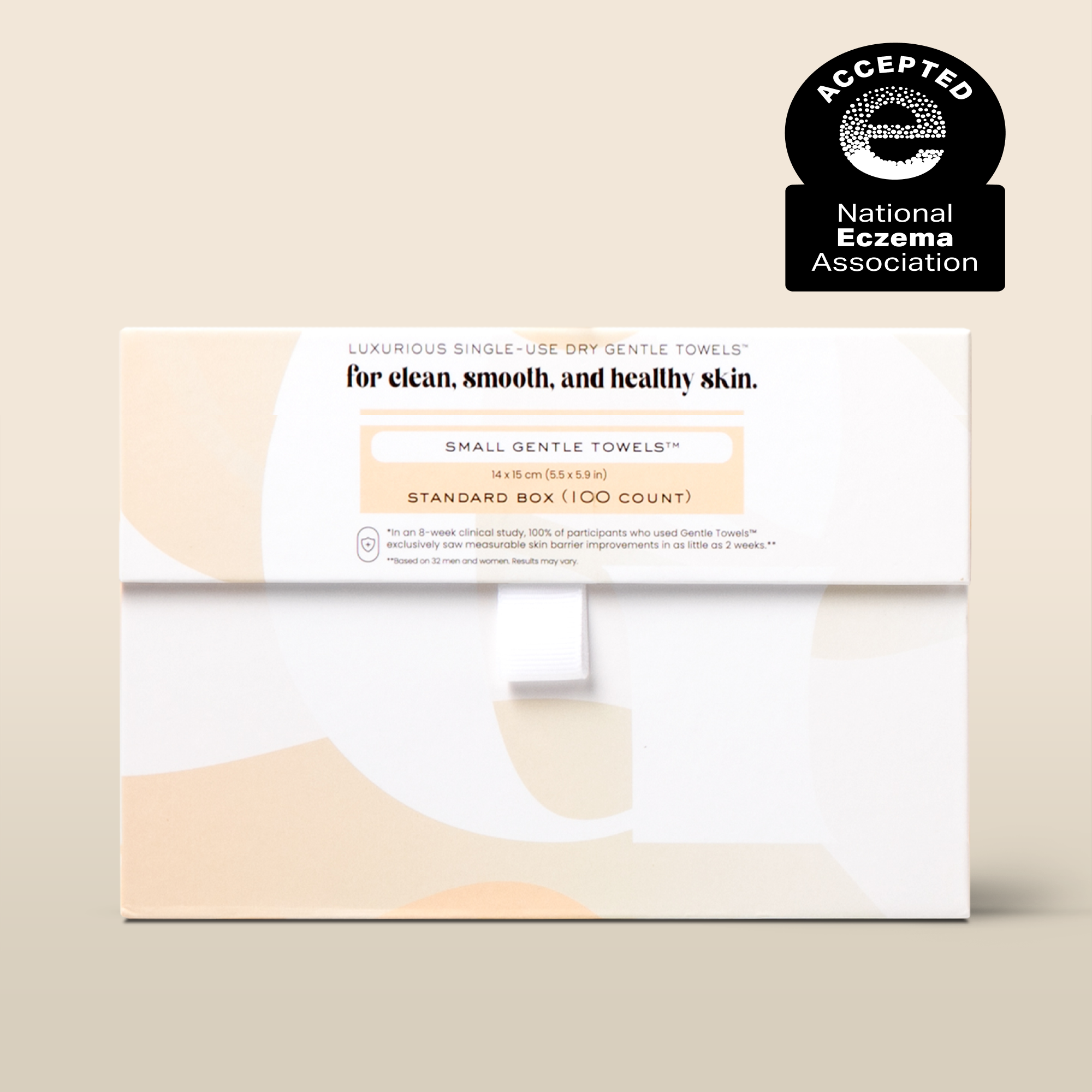
Gentle Towels are clinically tested, fragrance-free single-use facial towels accepted by the National Eczema Association. They carry dermatologist and pediatrician approval, which matters if you are buying for a child with eczema as well as yourself. The towels use wet or dry, so you can dampen one for cleansing and use a second dry towel to pat the face without rubbing. In practice, that two-towel method is what keeps friction off a reactive barrier.
Material and Softness: What to Look For
Softness in a disposable towel comes down to fiber type and how the cloth is bonded, not how thick it feels in the box. Look for bio-based fibers and a texture that glides rather than grips. A common mistake is choosing a towel that feels plush but has a raised, scrubby surface, which creates micro-tears on compromised skin.
Gentle Towels use USDA Bio-based materials and a smooth, ultra-soft surface. They are hypoallergenic and free of added fragrance, so there is no scent chemistry sitting on your skin after cleansing. If your skin reacts to everything, fragrance-free is the first filter, and softness is the second.
Durability and Residue Testing
A disposable towel should hold together when wet and leave nothing behind on the skin. Thin towels shred under light pressure and shed lint into your pores, while over-treated towels deposit residue that clogs acne-prone skin.
Test any towel with this quick check:
- Wet the towel and wring it gently. It should not tear or pill.
- Wipe a clean mirror with a damp towel. No film means no residue.
- Press the towel to your face and lift. It should release without pulling.
Gentle Towels pass all three: they stay intact wet or dry, and because they are fragrance-free and residue-free, they do not leave a coating behind.
Cost Per Use: Gentle Towels Pricing Breakdown
Per-towel cost drops sharply as pack size grows, which matters if you cleanse twice a day. Gently Radiant Skin prices its Gentle Towels in escalating counts, so the largest box delivers the lowest cost per use.
| Product | Towels | Price | Cost Per Use |
|---|---|---|---|
| Gentle Towels™ | Starter box | $17.50 | Varies by count |
| Gentle Towels™ 50 count | 50 | $18.00 | $0.36 |
| Gentle Towels™ 100 count | 100 | $32.00 | $0.32 |
| Gentle Towels™ 200 count | 200 | $60.00 | $0.30 |
| Gentle Towels™ Refill | Unlimited refills | $300.00 | Lowest long-term |
The 200-count box is the sweet spot for daily use, while the Refill option suits households that go through towels quickly. Mary I., a Gentle Towels customer, put it simply: "Gentle Towels are so convenient, and I love that they come in so many sizes."

How to Remove Makeup Without Scrubbing
The safest way to remove makeup without scrubbing is to dissolve first and wipe second. Scrubbing is what damages a sensitive barrier, so the goal is to let the product do the work and let the towel lift, not grind.
Follow this sequence:
- Apply a gentle oil or micellar cleanser to dry skin and let it sit for 20 seconds.
- Dampen one Gentle Towel and press it against the face for a few seconds to soften makeup.
- Wipe downward and outward in single, light passes. Do not rub back and forth.
- Fold the towel to a clean section for a second pass around the eyes and jaw.
- Finish with a dry towel pressed gently to remove residue, then moisturize.
The thing nobody tells you about makeup removal is that pressure, not product, causes most irritation. A soft, lint-free towel lets you use less pressure because the cloth grips makeup without needing friction. For sunscreen, which sits heavier than foundation, the damp-press step is essential. Customers often ask whether these towels actually lift makeup or just push it around; the answer is that a damp towel plus a dissolving cleanser lifts it, while a dry towel on dry makeup only smears.
Reusable vs Disposable Face Towels: Which Is Better for Sensitive Skin?
For reactive or acne-prone skin, disposable face towels are usually the better choice because they eliminate the transfer step entirely. But the reason is more specific than "washcloths are dirty," and understanding the mechanism helps you decide whether you actually need to switch.
What Happens to a Damp Washcloth Between Uses
A washcloth that stays damp in a bathroom holds moisture in its fiber matrix, and that moisture is the variable that matters. Most practitioners find that a cloth left damp for several hours in a warm, humid room creates conditions where bacteria and yeast can multiply quickly, and then you press that cloth against a barrier that is already compromised. The problem is not the fabric itself. It is the dwell time between "used" and "fully dry."
Three variables decide how bad that gets:
- Fabric weight and weave. Thick terry cloth holds far more water than a thin muslin or bamboo weave, so it stays damp longer. A heavy towel can still be visibly wet the next morning.
- Drying conditions. A towel hung on a bar in a closed bathroom with no airflow dries slowly. A towel spread flat near a vent or in direct sun dries in a fraction of the time.
- Wash temperature and frequency. Hot water plus a fragrance-free detergent is the baseline. Cold-water rinses and fabric softener leave residue and oils behind that feed the same problem.
If you wash a cloth after every single use in hot water, dry it fully, and store it dry, a reusable cloth can work for sensitive skin. Most people do not hit all three, and that is where breakouts and irritation start.
The Transfer Math
Here is the practical difference. A reusable cloth is a shared surface across days unless you wash it between every use. A single-use towel is a fresh surface every time, so nothing transfers from yesterday's cleanse to today's. For someone managing perioral dermatitis, fungal acne, or eczema flares, removing that variable is often the single change that stabilizes the routine.
When Reusable Still Makes Sense
Reusable cloths are not inherently bad, and for some people they are the better fit. If your skin is not reactive, if you have a laundry setup that lets you run a hot cycle frequently, and if you prefer the feel of a woven cotton or bamboo cloth, a reusable option can work. The trade-off is discipline, not material.
Disposable towels remove that discipline requirement. Each Gentle Towel is single-use, so nothing carries over. Pairing a single-use towel with a fragrance-free cleanser is the combination that tends to calm reactive skin rather than aggravate it. Fey E. found this difference at home: "The SheaX Fragrance-Free bar helped my daughter's eczema, and I'm genuinely amazed."
Sustainability and Certification: Micro-Plastics and Biodegradability
Most guides in this category say "look for eco-friendly options" and stop there. That is not useful if you have sensitive skin, because the fiber a towel is made from affects both what sheds onto your face and what ends up in the waste stream.
Compostable vs. Biodegradable vs. Bio-based: They Are Not the Same Claim
These three terms get used interchangeably in marketing, but they describe different things:
- Bio-based means the carbon in the material comes from a renewable plant or agricultural source rather than petroleum. It says nothing about what happens after disposal. A bio-based plastic can still persist for decades.
- Biodegradable means microorganisms can break the material down over time, but the timeframe and conditions are not specified. In a sealed landfill with no oxygen or moisture, "biodegradable" material can sit largely intact for years.
- Compostable is the strictest claim. It means the material breaks down into non-toxic components within a defined timeframe under specific conditions, and it is typically verified by a third-party standard rather than self-declared.
The practical takeaway: a towel can be bio-based and still not compost in a home bin. If landfill impact is your concern, compostability is the claim to look for.
Micro-Plastic Shedding: Why Fiber Choice Matters for Sensitive Skin
Many disposable towels are made from polyester or polypropylene, which are synthetic plastics. When those fibers break down, through wetting, wringing, or friction against the face, they can shed micro-plastics. For sensitive skin, there is a second concern beyond the environment: synthetic fibers and the finishes applied to them are more likely to leave residue or trigger irritation than clean plant-based fibers.
A USDA Bio-based label confirms the product's content is derived from renewable plant or agricultural sources, and it is verifiable through the USDA BioPreferred program. That is a third-party check, not a slogan. Gentle Towels carry USDA Bio-based certification and are accepted by the National Eczema Association, so both the material claim and the skin-safety claim rest on an authority rather than marketing copy.
How to Read a Towel Label in 30 Seconds
- Find the fiber content. If it lists polyester, polypropylene, or "synthetic blend," it is plastic-based.
- Look for a certification mark, not a word. USDA BioPreferred, compostability standards, and eczema association acceptance are checkable.
- Check for added fragrance or optical brighteners. These are common in whitened or scented towels and are frequent triggers for reactive skin.
- Confirm the storage format. A sealed or magnetic-flap box keeps towels dry and limits contamination between uses.
For families trying to avoid micro-plastic shedding while protecting reactive skin, bio-based fibers with a verifiable certification are the benchmark. You can also review general guidance on reducing single-use plastics from the EPA to understand how fiber choice affects waste. If you want to understand why barrier health responds to gentle cleansing, the American Academy of Dermatology's guidance on sensitive skin care is a solid reference.
Frequently Asked Questions
Is the Clean Skin Club worth it if I have sensitive skin?
Clean Skin Club towels are popular, but sensitive skin needs more than just softness. Look for fragrance-free, dermatologist-approved, and hypoallergenic options. Gentle Towels from Gently Radiant Skin are accepted by the National Eczema Association and clinically tested to improve skin barrier in 2 weeks. They are USDA Bio-based, so they avoid harsh chemicals that can trigger reactive skin.
What are the differences between Clean Skin Club towels and standard cotton towels?
Standard cotton towels are reusable and can harbor bacteria, which is a problem for acne-prone or reactive skin. Disposable face towels like Gentle Towels are single-use, lint-free, and residue-free, reducing the risk of bacterial transfer. They are also softer.
What are the best face cleansing cloths for sensitive skin?
The best face cleansing cloths for sensitive skin are fragrance-free, hypoallergenic, and made from bio-based fibers. Gentle Towels are dermatologist and pediatrician approved, accepted by the National Eczema Association, and clinically tested for sensitive skin. They are ultra-soft, absorbent, and can be used wet or dry for makeup removal without scrubbing.
Are disposable face towels actually better for your skin?
Yes, for many people with sensitive or acne-prone skin, disposable face towels are better because they prevent the buildup of bacteria and allergens that can occur with reusable cloths. Gentle Towels are single-use and free from fragrances and harsh chemicals. They help maintain a healthy skin barrier and reduce irritation.
How do I choose the right facial wipe for my sensitive skin?
Check for certifications like National Eczema Association acceptance, USDA Bio-based, and dermatologist approval. Avoid fragrances, alcohol, and harsh preservatives. Gentle Towels meet these criteria and are clinically proven to improve skin barrier in 2 weeks. Also consider cost per use to match your eco-conscious values.