


YOUR BATHROOM TOWEL
Might Be Undoing Your Facial Routine
A science-backed look at towels, bacteria, and the often-overlooked step in skincare: what touches your skin during and right after cleansing.
Most people optimize actives, treatments, and moisturizers. But if your towel stays damp, gets reused, and hangs in a humid bathroom, it can become an unpredictable variable in your skincare routine—especially for sensitive or acne-prone skin.
The 60-second takeaway
SEE GENTLE TOWELS™ CLINICAL TESTING PROTOCOL
Towels can develop complex microbial communities over time, including biofilm structures observed under real-life daily use (Kato et al., 2023)

Household towel studies show bacterial presence is common, and damp towels can contribute to cross-contamination (Gerba et al., 2014).

“Clean textile” hygiene isn’t just washing—handling + thorough drying matter for reducing contamination / recontamination

In Gentle Towels™ clinical testing, changing only the towel step (without changing skincare) was associated with measurable changes over 8 weeks.


Why bathroom towels can get “yucky”
(Even When They Look Clean)
Towels are designed to absorb water—so they also trap moisture + skin residue in their fibers. When a towel stays damp, dries slowly, or is reused between washes, it creates the kind of environment where microbes can persist and build up over time (Gerba et al., 2014; Kato et al., 2023).
5 reasons towels become an “invisible variable”
1
Humidity + Warmth
Moist environments support microbial persistence on textiles and surfaces (CDC, 2024).
4
Re-use compounds exposure
Each reuse increases contact with whatever has accumulated since the last wash/dry cycle
2
Hidden Dampness
A towel can feel dry-ish but still retain moisture in the fibers—especially when bunched or folded
5
Microbial communities can develop over time
In a 6-month real-life towel study, researchers observed biofilm structures on towels over time and described towel-specific microbial patterns
3
Residue Buildup
Oils, dead skin, makeup, and product residue can cling to fibers and accumulate between washes (Gerba et al., 2014).
Is this a skincare issue or a towel issue?
Not every flare-up is caused by towels. But towels are a repeat-contact surface—and repeat contact matters when skin is reactive. If your skin feels:
Irritated
FOR NO
CLEAR
REASON
Tight
AFTER
CLEANSING
Unpredictable
DESPITE
“GOOD”
PRODUCTS
it’s worth examining the drying/patting step as a potential contributor.


Quick self-check
7 signs your face towel might be working against you
1
It hangs in the bathroom and dries slowly
2
It’s used more than once before washing
3
It’s shared or used for multiple purposes
4
It’s bunched/folded between uses
5
It sometimes smells “fine-ish” while damp
6
Your routine is consistent, but results aren’t
7
You’ve never thought about the towel step (most people haven’t)
THE “LESS YUCK” CHECKLIST
IF YOU INSIST ON A REUSABLE CLOTH TOWEL
Use a dedicated
face towel

Swap often (don’t
stretch USE BETWEEN WASHES)

Dry fully between
uses (spread it out—
don’t bunch it)

Wash
appropriately
(follow label)

Dry
thoroughly

Store clean
towels in a
drier area


A practical alternative
single-use facial towels (and what to look for)
If you want to reduce the yucky reusable towel variable completely, single-use facial towels can make the “after cleanse” step more consistent. The idea is simple: a fresh towel every time, with less guesswork about dampness, residue, or “is this actually clean?”
What matters
(because quality varies)

Soft, low-friction feel
(facial skin doesn’t need tugging)

Low lint
(less residue left behind)

Clean handling + protective packaging
(keeps towels clean until use)

Third-party standards
(helps validate what “clean” means)

Skin compatibility
(especially if you’re sensitive or acne-prone)
Why Gentle Towels™
stands out
BECAUSE not all single-use towels are equal
SHOP GENTLE TOWELS™
Made for faces (not multipurpose wipes)
Designed for facial skin and the post-cleanse step—so the focus is softness and low friction.

Ultra-soft + low-friction feel
Gentler contact helps reduce the “tugging” that can make skin feel tight or irritated after cleansing.

Prepared with an ozone purification step
An added preparation step to support a clean standard before the towels are packaged

Protected until you use it
Clean handling and protective packaging so towels stay fresh inside the box—then you use one and you’re done.

Third-party trust markers
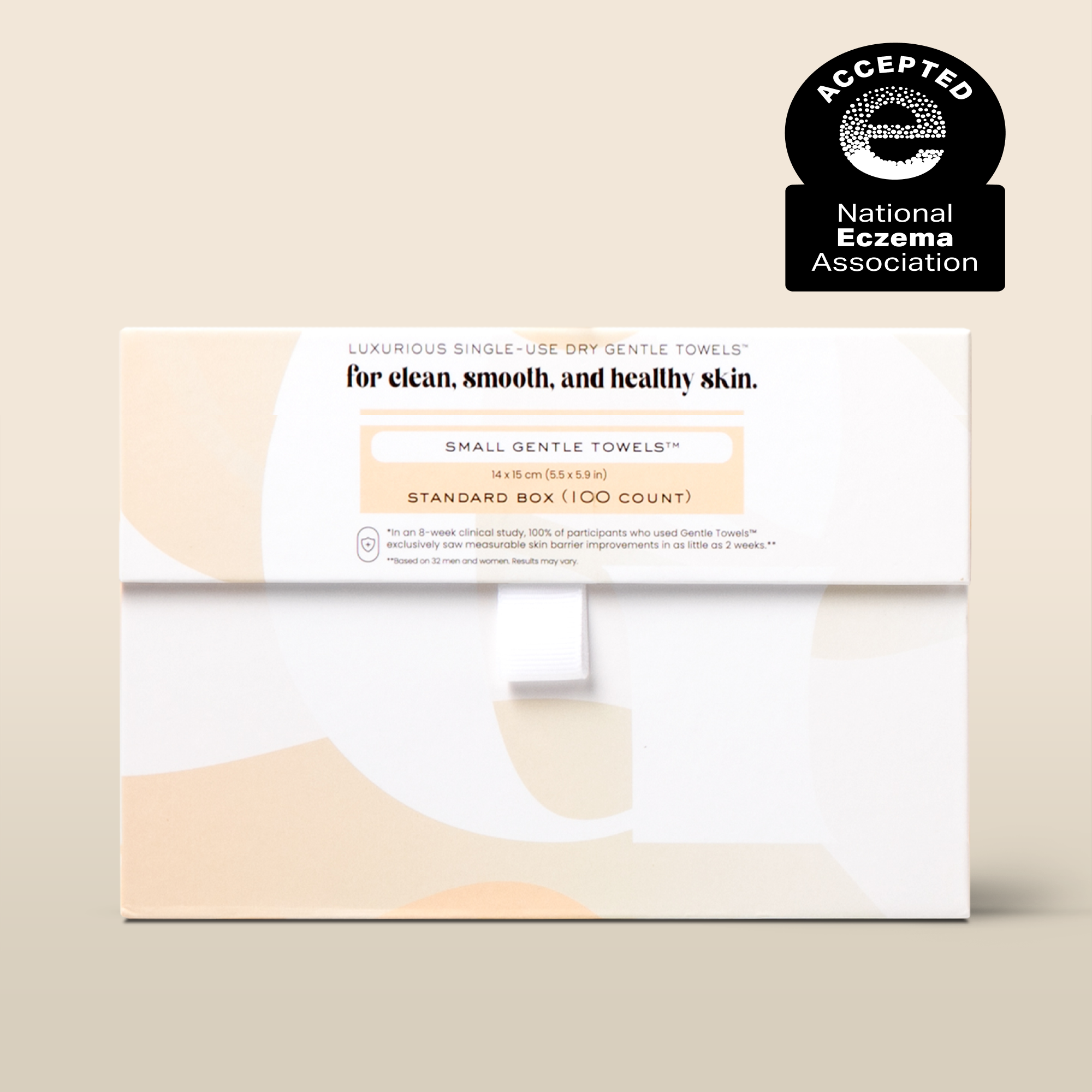
Held to standards like OEKO-TEX® certification, 100% USDA BioBased, and accepted by the National Eczema Association (plus it’s dermatologist and pediatrician tested).

Backed by clinical testing
Evaluated in two independent clinical studies—one focused on skin compatibility, and one on an 8-week routine switch (changing only the towel step)


Clinical testing supports the suitability of Gentle Towels™ for repeated dermal exposure, including in populations with sensitive skin.
GENTLE TOWELS™
What happened when only the towel step changed (clinical summary)
Gentle Towels™ have been evaluated in two independent clinical studies—one for skin compatibility, one for an 8-week routine switch.
Clinical Study 1
Skin Compatibility & Sensitization (HRIPT)
A 42-day study with 108 participants (including self-identified sensitive skin) reported Gentle Towels™ were non-sensitizing, with no sensitization reactions observed and no adverse events reported.
42
Day Study
108
Participants
Proven non-sensitizing, including in participants with sensitive skin.
Clinical Study 2
8-Week Home-Use Routine Switch (no skincare routine changes)
An 8-week study (32 participants; 2× daily use; no skincare routine changes permitted) tracked barrier measurement (TEWL), clinical grading, acne severity (IGA), lesion counts, and user surveys.

Skin Barrier
100%
of Participants beginning at Week 2

Facial Blemishes
58.7%
Reduction at Week 8

Acne Severity
22%
Improvement in IGA Score at Week 8
Important context: This evaluated a habit change (switching what touches skin after cleansing), not a medicated treatment.
*Individual results vary. Gentle Towels™ contain no active treatment ingredients and are not intended to diagnose, treat, cure, or prevent any skin
Before & After (routine switch from reusable cloth towels to Gentle Towels™ )
These photos show a participant after switching from reusable fabric towels to Gentle Towels™ after cleansing.

Before Gentle
Towels ™

After 2 weeks switching
to Gentle Towels ™
IMPROVEd SKIN BARRIER FUNCTION (TEWL) at week 2

Before Gentle
Towels ™

After 8 weeks switching
to Gentle Towels ™
improved
ACNE SEVERITY
at week 8
Note: Gentle Towels™ contain no active treatment ingredients and are not intended to diagnose, treat, cure, or prevent any skin condition.*

THE TAKEAWAY
If your routine feels inconsistent, it may not always be your products.
Sometimes it’s the overlooked variable: what you dry with after you cleanse.